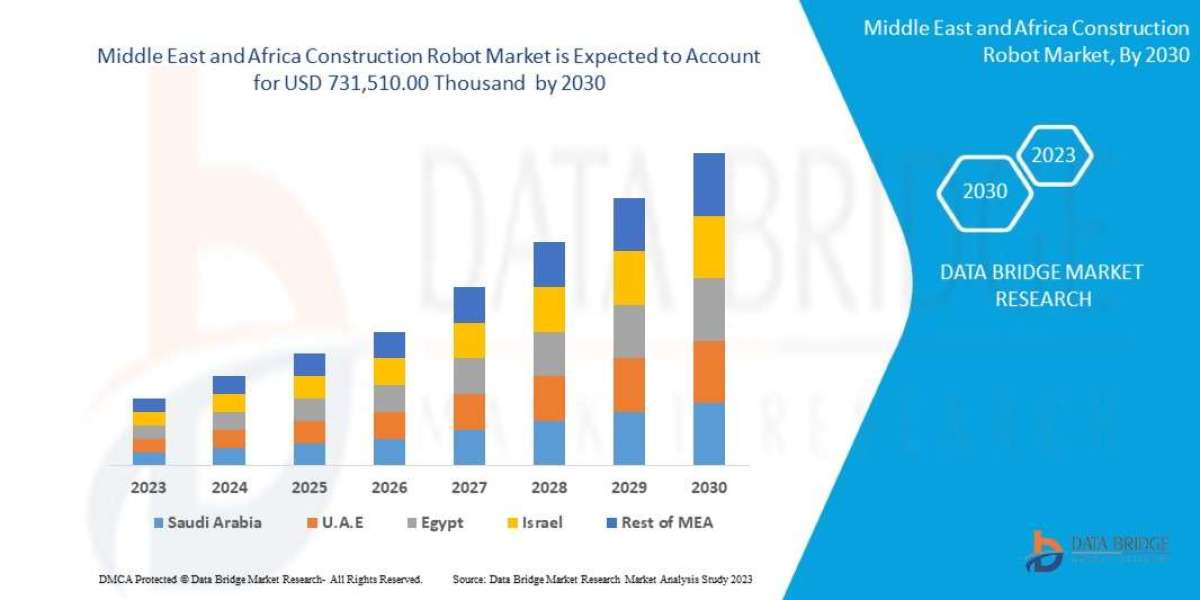

The Middle East and Africa Construction Robot Market is accelerating. Expected to reach USD 731,510.00 thousand by 2030, the market will grow at a compound annual growth rate (CAGR) of 8.7% from 2023 to 2030. This article examines market dynamics, segmentation, drivers, challenges, and competitive strategies, drawing exclusively from Data Bridge Market Research to inform stakeholders on emerging opportunities.
What Are Construction Robots?
Construction robots are automated machines designed to perform repetitive, hazardous, or precision tasks on job sites, such as demolition, material handling, welding, and 3D printing. They integrate advanced technologies like sensors, AI, and autonomous navigation to minimize human error, reduce costs, and enable 24/7 operations. In the MEA region, they are pivotal for tackling harsh environments and supporting sustainable building practices amid rapid urbanization.
Market Size and Growth Projections
The MEA construction robot market is fueled by infrastructure booms and technological adoption, with projections based on 2022 as the base year. Historical data from 2021 (customizable to 2015-2020) informs forecasts through 2030, measured in USD thousand for revenue and pricing.
| Year/Period | Market Value (USD Thousand) | CAGR (%) |
|---|---|---|
| Base Year (2022) | Not specified (reference base) | - |
| Forecast (2023-2030) | Projected to 731,510.00 by 2030 | 8.7 |
| Historical (2021) | Customizable data available | - |
The U.A.E. dominates due to robust R&D, technological advancements, and automation adoption, followed by Saudi Arabia and South Africa.
Download Full Report Here : https://www.databridgemarketresearch.com/reports/middle-east-and-africa-construction-robot-market
Market Segmentation
The market is segmented to reveal high-growth areas:
By Robot Type
- Articulated Robots: Dominant for flexible tasks like welding and assembly.
- Exoskeleton: Growing for worker augmentation in heavy lifting.
- Cartesian Robot: Preferred for linear precision in material handling.
- Automated Guided Vehicle: Essential for site logistics.
- Others: Including specialized demolition units.
By Payload Capacity
- Less Than 500 Kg: Largest share for light-duty applications.
- 500-3000 Kg: Balanced for mid-scale operations.
- 3001 Kg & Above: For heavy infrastructure projects.
By Axis Type
- 3 Axis: Basic efficiency in straightforward tasks.
- 4 Axis: Enhanced maneuverability.
- 5 Axis: High-precision for complex structures.
- Others: Multi-axis innovations.
By Automation
- Fully Autonomous: Fastest-growing for unmanned operations.
- Semi-Autonomous: Widespread for hybrid human-robot workflows.
By Function
- Demolition: Critical for site preparation.
- Structure Processes: Includes bricklaying, welding, fastening, and concrete erection.
- Material Handling: Streamlines logistics.
- Finishing & Assembling: Covers drilling, painting, and cleaning.
- 3D Printing: Emerging for rapid prototyping.
- Quality Inspection: Ensures compliance.
- Layout: For accurate site mapping.
- Others: Niche applications.
By Vertical
- Commercial & Residential Infrastructure: Largest segment amid urban growth.
- Public Infrastructure: Driven by government projects.
- Energy & Utility: For power and oil/gas facilities.
- Others: Industrial and specialized builds.
By Product Type
- On-Site Production Robot: Dominant for real-time fabrication.
- Pre-Fab Construction Robot: Gaining for modular efficiency.
By Country
- U.A.E.: Regional leader with tech-driven adoption.
- Saudi Arabia: Boosted by mega-infrastructure.
- South Africa: Steady growth in mining-linked construction.
- Egypt: Urban renewal focus.
- Israel: Innovation in robotics R&D.
- Rest of MEA: Emerging in oil-rich nations.
Key Drivers Fueling Growth
- Urbanization Surge: Rapid global urbanization increases demand for efficient, scalable construction methods in densely populated MEA cities.
- Productivity Enhancements: Robots cut time and costs in tasks like bricklaying and demolition, enabling faster project timelines.
- Sustainable Practices: Alignment with green building standards reduces waste and energy use.
- Technological Advancements: Progress in robotics, including AI and sensors, improves precision and adaptability.
- Safety Improvements: Robots handle hazardous environments, minimizing worker risks in extreme MEA conditions.
Challenges and Restraints
- High Costs: Substantial initial investments, plus ongoing training, maintenance, and repairs, deter small firms.
- Skilled Labor Shortages: Lack of expertise in operating and maintaining advanced robots.
- Awareness Gaps: Limited knowledge of robotics benefits slows adoption in traditional sectors.
Opportunities
- Automation Demand: Rising labor costs and shortages drive site automation, exemplified by MIT's Autonomous Robotic Construction Systems (ARCS).
- Strategic Collaborations: Partnerships expand technology access and market reach.
- 3D Printing Adoption: Revolutionizes custom, rapid construction in remote or urban areas.
Competitive Landscape
The market is competitive, with global and regional players pursuing partnerships and expansions:
- ABB
- Husqvarna AB
- Komatsu Ltd.
- Fujita Corporation
- FBR Ltd
- Conjet
- Contour Crafting Corporation
- MX3D
- CyBe Construction
- KEWAZO BROKK GLOBAL
- RobotWorx
- Built Robotics
- ICON Technology, Inc.
- Dusty Robotics
- MUDBOTS 3D CONCRETE PRINTING, LLC
- Advanced Construction Robotics, Inc.
- NASKA.AI
- nLink AS
- Okibo
Recent developments include FBR Ltd's March 2023 agreement with M&G Investment Management for U.S. manufacturing of Hadrian X robots, and Conjet's September 2022 partnership with Doornbos Equipment BV for BENELUX distribution, signaling global strategies relevant to MEA expansion.
Future Trends and Opportunities
By 2030, trends will center on fully autonomous systems and 3D printing for 24/7 precision operations. Post-COVID recovery accelerates via government automation initiatives and aviation sector rebounds. Focus on sustainable, sensor-integrated robots in the U.A.E. and Saudi Arabia will drive R&D, with opportunities in public infrastructure and energy verticals amid skilled labor gaps.
Conclusion
The Middle East and Africa Construction Robot Market is on track for strong growth to USD 731,510.00 thousand by 2030 at 8.7% CAGR, propelled by urbanization and tech innovations. Stakeholders should mitigate cost barriers through partnerships and training to capitalize on automation waves in key countries like the U.A.E. and Saudi Arabia. Embracing 3D printing and AI will position players for sustained leadership.
Browse More Reports:
Global Phototherapy Equipment Market
Global Wide Body Aircraft Market
Global Automotive Plastics for Electrical Vehicle Market
Global Feed Mycotoxin Modifiers Market
Global Organic Quinoa Flour Market
Global Portable Speakers Market
Global Baby Monitors Market
Global Liver Function Test Market
Global Luxury Rigid Boxes Market
Global Private Cloud Migration Market
Global Virtual Payment (POS) Terminals Market
Global Bortezomib Market
Global Dunnage Air Bags Market
Global Rubber Additives Market
Global Damask Rose Water Market
About Data Bridge Market Research:
An absolute way to forecast what the future holds is to comprehend the trend today!
Data Bridge Market Research set forth itself as an unconventional and neoteric market research and consulting firm with an unparalleled level of resilience and integrated approaches. We are determined to unearth the best market opportunities and foster efficient information for your business to thrive in the market. Data Bridge endeavors to provide appropriate solutions to the complex business challenges and initiates an effortless decision-making process. Data Bridge is an aftermath of sheer wisdom and experience which was formulated and framed in the year 2015 in Pune.
Contact Us:
Data Bridge Market Research
US: +1 614 591 3140
UK: +44 845 154 9652
APAC : +653 1251 975
Email:- corporatesales@databridgemarketresearch.com