
Executive Summary North America Indoor LED Lighting Market Industry Analysis
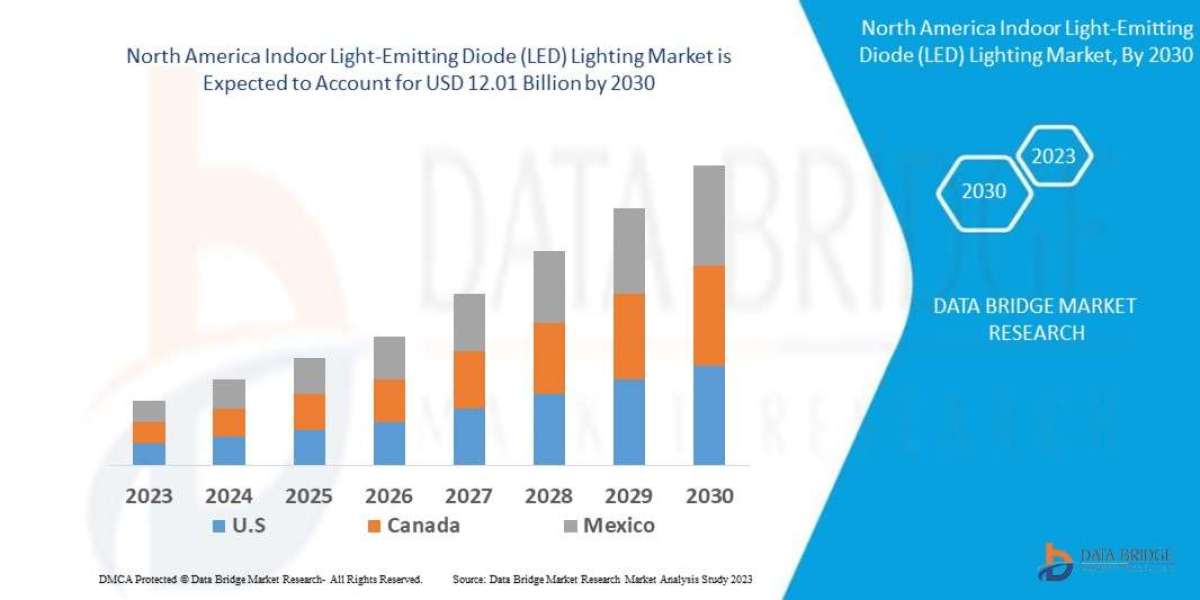
The North America indoor LED lighting market has been experiencing strong, sustained growth driven by rising energy-efficiency demands, technological advancements, and widespread adoption of smart lighting systems. The market was valued at approximately USD 6.90 billion in 2022 and is projected to grow at a CAGR exceeding 10% through 2030, reaching around USD 12.01 billion. Longer-term forecasts indicate the market could surpass USD 13 billion by 2032 as commercial, residential, and industrial sectors continue transitioning toward efficient LED solutions.
This report provides a comprehensive analysis of key market dynamics, segment insights, drivers, restraints, and strategic growth opportunities for major stakeholders.
Market Overview
Indoor LED lighting has transformed from a niche energy-saving alternative into the dominant lighting technology across homes, offices, and industrial facilities in North America. The shift is supported by improving LED affordability, superior efficiency, regulatory pressure for sustainable lighting solutions, and the rise of IoT-enabled smart lighting systems.
The market is broadly segmented by product type, wattage, installation type, offering, and application. Among these, commercial spaces represent the largest and fastest-growing application area, while new construction projects account for the majority of installations.
Market Size and Forecast
2022 Market Value: ~USD 6.90 billion
2030 Forecast Value: ~USD 12.01 billion
Forecast CAGR (2023–2030): ~10.23%
2032 Future Potential Market Value: ~USD 13.31 billion
Forecast CAGR (2025–2032): ~17.45%
The consistent growth is driven by high adoption in commercial facilities, institutional buildings, and urban residential projects. Increasing retrofitting activities across the region further support market expansion.
Market Segmentation
1. Product Type
Lamps
Luminaires
Luminaires dominate the segment due to their widespread use in commercial and industrial environments, where integrated fixtures offer better design flexibility and energy savings.
2. Wattage
Below 50 W
50–150 W
Above 150 W
The 50–150 W segment leads the market and is expected to grow at the highest rate due to its suitability for offices, retail outlets, showrooms, and other frequently used indoor spaces.
3. Installation Type
New Installation
Retrofit Installation
New installations hold the largest share due to new building construction across North America. This segment is also the fastest-growing as sustainability regulations increasingly mandate energy-efficient lighting in new projects.
4. Offerings
Hardware
Software
Services
Hardware remains dominant because physical LED fixtures and components account for the majority of market revenue. However, the software and services segments are expanding rapidly with growing demand for smart lighting controls, automation, and maintenance services.
5. Application
Commercial
Residential
Automotive
The commercial segment leads the market with the highest revenue contribution. Offices, shopping malls, warehouses, hospitals, schools, and public facilities are rapidly upgrading to LED systems due to long-term cost savings and regulatory compliance.
Full Report Here : https://www.databridgemarketresearch.com/reports/north-america-indoor-led-lighting-market
Key Market Drivers
1. Rising Focus on Energy Efficiency
LED lighting consumes significantly less energy than traditional lighting technologies. As businesses and households aim to reduce electricity bills, LEDs have become the preferred choice. Their long lifespan also lowers replacement and maintenance costs.
2. Growth of Smart Lighting and IoT Integration
Smart indoor LED lighting systems—featuring automation, dimming controls, sensors, and remote-access management—are rapidly adopted in smart homes and smart commercial buildings. This trend enhances user experience and energy optimization.
3. Regulatory Push Toward Sustainability
Government regulations across North America increasingly restrict inefficient lighting systems. Energy-efficiency certifications and sustainability standards encourage adoption of LEDs in both residential and commercial environments.
4. Expanding Construction and Retrofit Projects
Commercial and residential construction projects across the region continue to include LED installations as part of default building specifications. Retrofits in older buildings further drive market demand, especially across office and public infrastructure.
5. Advancements in LED Technology
LEDs now offer improved brightness, color quality, heat management, and design versatility. Falling production costs make LEDs more accessible, accelerating market penetration across all application segments.
Market Restraints
1. High Initial Investment
Despite declining prices, LED lighting still has a higher initial installation cost compared to traditional options. Small businesses and low-income households may delay upgrades due to budget constraints.
2. Limited Awareness Among Certain User Groups
Some user segments remain unaware of long-term LED benefits such as reduced electricity costs and improved lifespan. This slows adoption in certain residential or rural areas.
3. Market Saturation in Early-Adoption Regions
As early adopters—including large commercial buildings—have already completed their transitions, future growth in some areas may experience a moderate slowdown, especially for standard LED products.
Opportunities
1. Expansion of Smart Building Ecosystems
Integration of LED lighting with smart building management systems, sensors, automation, and cloud platforms offers significant revenue potential.
2. Demand for Human-Centric Lighting (HCL)
LEDs that mimic natural daylight and support well-being are gaining popularity in offices, hospitals, and educational institutions.
3. Growth in Industrial and Warehouse LED Adoption
As industries pursue efficiency, LEDs are replacing outdated fluorescent systems in production halls and warehouses.
4. Increased Government Incentives
Rebate programs, tax credits, and sustainability mandates encourage businesses and homeowners to adopt LED lighting faster.
Competitive Landscape
The market includes multinational lighting manufacturers, technology innovators, and regional brands focusing on customized LED solutions. Key strategies include product innovation, energy-efficiency improvements, smart control systems, partnerships with automation companies, and expansion into commercial construction sectors.
Conclusion
The North America indoor LED lighting market is poised for strong and sustained growth, supported by rising demand for energy-efficient technologies, smart lighting integration, and the expansion of commercial and residential construction. With a projected CAGR above 10% through 2030 and significant future potential beyond 2032, indoor LED lighting will continue to play a critical role in energy conservation, modern building infrastructure, and sustainable development across the region.
Browse More Reports:
Global Garden and Lawn Tools Market
Global Prepreg Market
Global Quantum Communication Market
Global Automotive Ethernet Testing Market
Global Microscopes Slides Market
Global Self-Service Business Intelligence (BI) Market
Global Sterile and Antiviral Packaging Market
Global Vertical Turbine Pump Market
Global Antimicrobials Market
Global Wireless Radio Frequency Transceivers Market
North America Tissue Paper Market
Europe Paper and Paperboard Packaging Market
Middle East and Africa Melanoma Cancer Diagnostics Market
Europe Invisible Orthodontics Market
Asia-Pacific Flow Cytometry Market
About Data Bridge Market Research:
An absolute way to forecast what the future holds is to comprehend the trend today!
Data Bridge Market Research set forth itself as an unconventional and neoteric market research and consulting firm with an unparalleled level of resilience and integrated approaches. We are determined to unearth the best market opportunities and foster efficient information for your business to thrive in the market. Data Bridge endeavors to provide appropriate solutions to the complex business challenges and initiates an effortless decision-making process. Data Bridge is an aftermath of sheer wisdom and experience which was formulated and framed in the year 2015 in Pune.
Contact Us:
Data Bridge Market Research
US: +1 614 591 3140
UK: +44 845 154 9652
APAC : +653 1251 975
Email:- corporatesales@databridgemarketresearch.com