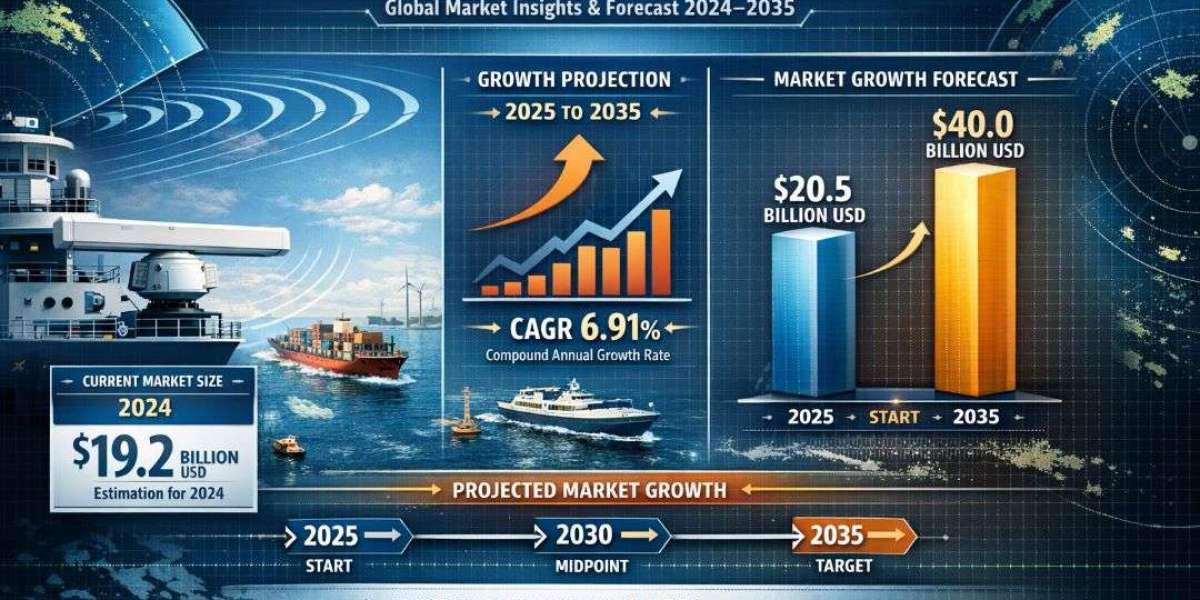

As highlighted by Market Research Future analysis, the Marine Radar Market Size was estimated at 19.2 USD Billion in 2024. The Marine Radar industry is projected to grow from 20.5 USD Billion in 2025 to 40.0 USD Billion by 2035, registering a CAGR of 6.91% during the forecast period 2025–2035. Naval radar systems play a critical role in maritime defense by enabling surveillance, navigation, and threat detection across vast ocean areas. These systems support both coastal security and open-sea operations.
Modern maritime radar technology has evolved to meet complex naval requirements, integrating advanced radar imaging technology with real-time data processing capabilities. As naval fleets modernize, radar systems remain central to operational effectiveness.
Market Growth and Trends
Rising geopolitical tensions and the need for maritime domain awareness are key factors driving investment in naval radar systems. Governments continue to upgrade fleets with advanced marine radar systems capable of multi-role operations. Vessel traffic radar also supports naval coordination in congested waterways and strategic maritime zones.
Technological advancements include the increased use of solid-state marine radar, which offers greater reliability and faster response times. S-band marine radar is commonly employed for long-range surveillance, while X-band marine radar provides detailed short-range tracking. Doppler marine radar enhances target discrimination by analyzing movement patterns.
Radar signal processing has improved significantly, enabling naval operators to filter noise and detect small or fast-moving objects. Integration of AIS and radar supports cooperative surveillance and identification, particularly during joint maritime operations.
Key Players
Key players supplying naval radar systems focus on performance, resilience, and interoperability. These organizations invest heavily in research to enhance radar imaging technology and processing algorithms. Collaboration with defense agencies ensures compliance with operational and security requirements.
The competitive landscape emphasizes long-term system upgrades and lifecycle support, ensuring sustained operational readiness for naval forces.
Future Scope
The future of naval radar systems lies in increased automation and multi-sensor integration. Artificial intelligence is expected to improve radar signal processing by enabling faster threat identification and response. Networked vessel traffic radar systems may enhance coordinated defense strategies across maritime regions.
As naval operations expand to include unmanned platforms, marine navigation radar will adapt to support both manned and autonomous assets. Continuous innovation will remain essential to maintaining maritime security and surveillance capabilities.
FAQ
What is the primary role of naval radar systems?
They support navigation, surveillance, and threat detection for maritime defense operations.
Why is S-band radar preferred for naval use?
It offers long-range detection and reliable performance in challenging weather conditions.
How does radar imaging technology support defense missions?
It provides detailed target visualization for accurate identification and tracking.
Discover More Research Reports on Aerospace & Defense By Market Research Future: